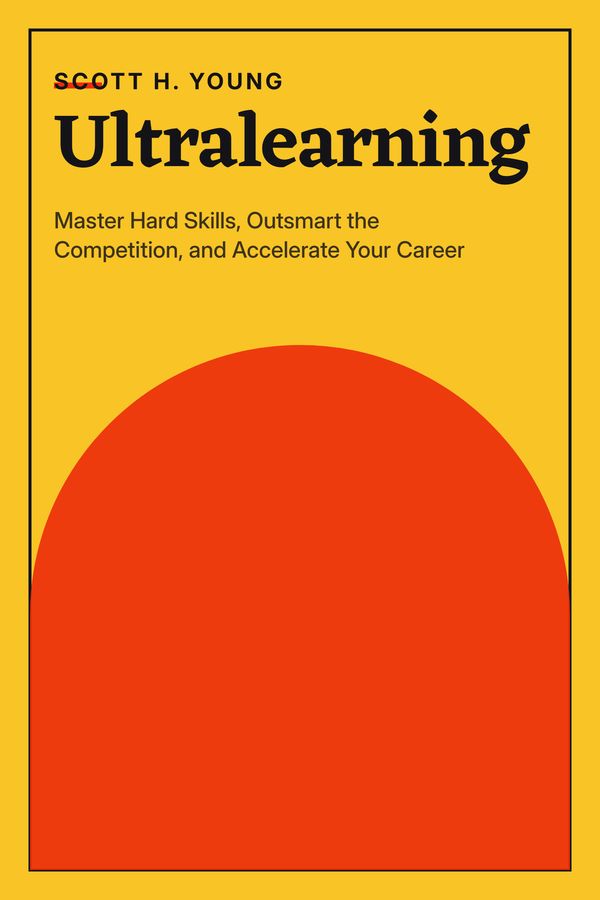
Ultralearning summary
Master Hard Skills, Outsmart the Competition, and Accelerate Your Career
The book in one sentence
You can master hard skills far faster than school suggests by running short, intense, self-directed learning projects built on nine practical principles.
Overview
Scott Young once passed MIT's four-year computer science curriculum in a single year, studying alone from free online material. He argues this kind of feat isn't about genius. It's a repeatable strategy: intense, self-directed learning built on nine principles that anyone can copy to master hard skills fast.
Key idea 1: What Ultralearning Really Is
The book opens with Tristan de Montebello, a guy with a normal job and no special talent for public speaking. He decided to get good, fast. Within about seven months of taking it seriously, he reached the finals of the World Championship of Public Speaking, beating out tens of thousands of people. He didn't do it by signing up for a class and waiting. He threw himself at the skill, found coaches, spoke constantly, and treated it like a mission. Young calls this kind of push ultralearning.
So what is it? Young defines ultralearning as a strategy for learning that is both self-directed and intense. Self-directed means you decide what to learn and how, instead of handing that choice to a school or a boss. Intense means you go after the skill with real focus rather than letting it happen slowly in the background. The most famous example is Young's own. He wanted a computer science education but not the debt, so he took MIT's published course materials, which the school posts online for free, and worked through the whole four-year curriculum in about twelve months. He passed the final exams and finished the programming projects on his own.
Why does this matter to you? Because the story we tell about learning is usually wrong. We assume fast learners are born, not made, and that deep skill only comes from years of formal schooling. Young's cases, from a solo video game maker to a polyglot who picks up languages in months, suggest otherwise. What these people share is not raw IQ. It is a method.
Here is how to start using it. Pick one skill you actually want, not a vague wish, and commit to a short, focused project with a clear finish line. That focus is the engine.
One nuance keeps this honest. Ultralearning is not about speed for bragging rights, and you don't have to quit your job to do it. It sits on a spectrum. Your project can take a few hours a week for a couple of months. What makes it ultralearning is the intensity and ownership you bring, not the size of the sacrifice.
7 more key ideas in the app
- 2. Draw The Map First
- 3. Learn The Real Thing
- 4. Attack Your Weakest Link
- 5. Test Yourself To Learn
- 6. Chase The Uncomfortable Feedback
- 7. Beat The Leaky Bucket
- 8. Understand It, Don't Memorize It
Did you know?
- Scott Young worked through MIT's four-year computer science curriculum in about twelve months using the school's free online course materials, passing the exams and completing the programming projects on his own.
- For his Year Without English project, Young and a friend spent roughly three months each in Spain, Brazil, China, and Korea, refusing to speak English from the day they arrived.
- The book opens with Tristan de Montebello, who reached the finals of the World Championship of Public Speaking within about seven months of getting serious about speaking.
Featured in: Peak Performance, Learn anything faster (guide)
 Unlimited Power
 You Are a Badass
 101 Essays That Will Change the Way You Think
 12 Rules for Life
 As a Man Thinketh