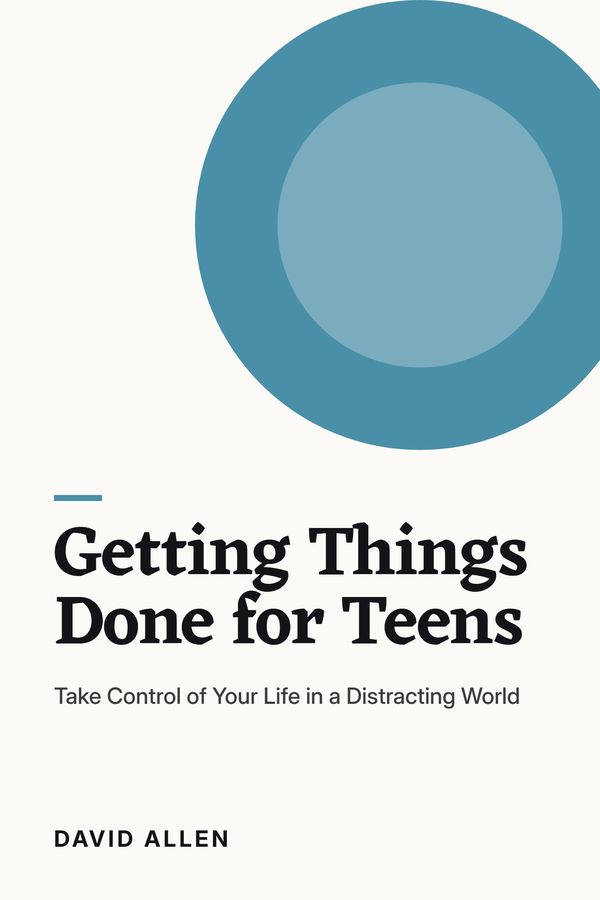
Getting Things Done for Teens summary
Take Control of Your Life in a Distracting World
The book in one sentence
You feel calmer and get more done when you move every task and worry out of your head and into a simple system you trust and check often.
Overview
David Allen took his famous productivity method and rewrote it for teens buried under homework, group chats, and packed schedules. The idea is simple. Your brain is bad at holding all your tasks, so you park them somewhere you trust and free your mind to focus on what is actually in front of you.
Key idea 1: Your Brain Makes a Terrible To-Do List
Think about the last time you lay in bed and your mind would not shut off. A project due Friday, a text you forgot to send, a permission slip lost somewhere in your backpack, that thing you promised a friend. None of it was getting done at midnight, but your brain kept reminding you anyway, over and over, at the worst possible time. David Allen calls these nagging thoughts open loops. An open loop is anything you have told yourself you should do that is not finished and not written down anywhere you trust. Every one of them takes up space in your head.
Here is the problem. Your brain is great at having ideas and solving problems, but it is terrible at storing them. It has no sense of time, so it reminds you to buy poster board at 2 a.m. instead of when you are actually at the store. It also cannot count. Whether you have two things to remember or forty, your mind treats each one like it might be the big thing you forgot, so a low buzz of stress never really switches off.
Allen says most people walk around with hundreds of these open loops running quietly in the background. You cannot see them, but you feel them as a tired, scattered mood. That feeling does not mean you are lazy or broken. Your brain is just doing a job it was never built for, which is being your filing cabinet.
The fix is the whole point of the book. You move every one of those loops out of your head and into a place you check often and actually trust. Once your brain believes the reminder is safely captured somewhere else, it stops nagging you about it. People describe the feeling as their head going quiet for the first time in a while.
You can test this tonight. Grab your phone or a notebook and dump out everything pulling at you, big or small, for ten minutes straight. Do not organize it, just get it all out. Most people are surprised at how much lighter they feel just from seeing it on a page instead of spinning in their skull.
7 more key ideas in the app
- 2. Capture It All in One Trusted Place
- 3. Turn Stuff Into a Next Action
- 4. The Two-Minute Rule
- 5. Organize So You Trust Where to Look
- 6. The Weekly Review Keeps It Alive
- 7. Aim for a Mind Like Water
- 8. Zoom Out to What You Actually Care About
Did you know?
- David Allen first laid out his method in Getting Things Done back in 2001, and it sold millions of copies to overworked adults long before he shaped a version for teenagers.
- The teen edition was written with two co-authors, Mike Williams and Mark Wallace, and it swaps office examples for school life like homework and group projects.
 How to Become a Straight-A Student
 How to Take Smart Notes
 Hyperfocus
 Indistractable
 Make Time