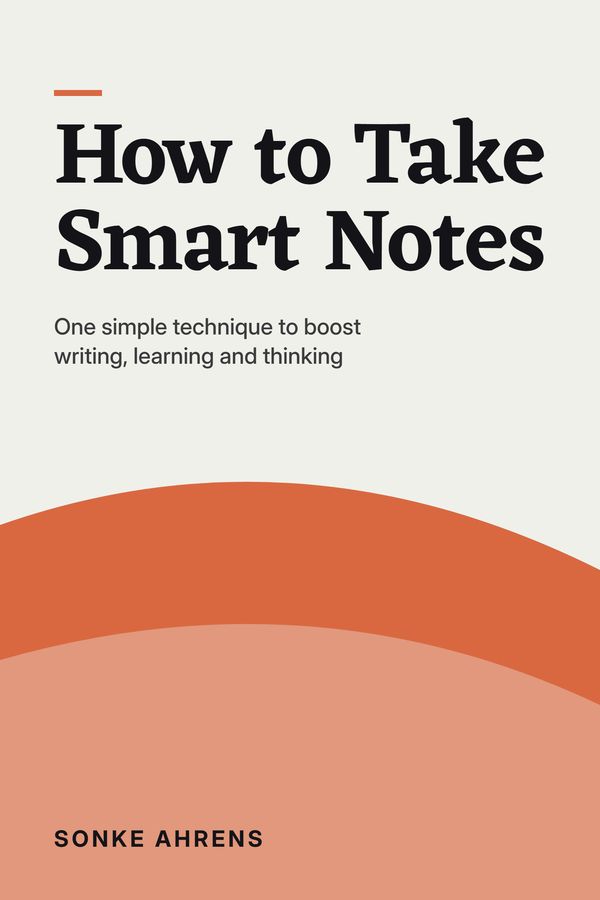
How to Take Smart Notes summary
One simple technique to boost writing, learning and thinking
The book in one sentence
Good writing and clear thinking come from taking smart, linked notes over time, so a reliable outside system does your remembering and hands you finished ideas when it is time to write.
Overview
Most advice on writing and study skips the part that matters: what you do with an idea the moment you meet it. Sonke Ahrens builds his answer around one tool, a simple box of linked notes, and shows how it turns reading into thinking and thinking into finished work.
Key idea 1: Nobody Starts From a Blank Page
The scariest moment for most writers is the empty screen. Ahrens says the fear is a sign that something went wrong much earlier, not that you lack talent. Nobody actually writes a good paper by sitting down and pulling ideas out of thin air. By the time you face the page, the real work has either been done or it hasn't. If you have spent weeks reading and taking notes, the page is not empty at all. You already have a pile of thoughts to arrange.
The trick is to treat writing as something you do all the time, not a single event at the end. When you read, you write down what caught your eye. When an idea shows up in the shower, you jot it on a scrap of paper. When you finish a book, you write a few lines about what you want to keep. None of this feels like Writing with a capital W, but it is the same activity. You are putting thoughts into words and words onto paper.
Ahrens points out that school teaches the opposite. We learn to brainstorm, pick a thesis, then hunt for sources that back it up. That order forces you to decide what you think before you have done the reading, which is backwards. It also makes the final write-up feel huge, because you are trying to think and phrase and structure all at once, under a deadline.
If instead you have been taking notes the whole time, the final paper becomes a job of sorting and smoothing. You lay your notes out, put related ones together, spot the gaps, and turn the sequence into paragraphs. The hard thinking already happened in small doses, on days when you were not panicking. To use this, stop saving your thoughts for one big session. Write a little every day as you read and think, and keep those bits where you can find them later. The blank page stops being a wall once you show up with a stack of notes in hand.
7 more key ideas in the app
- 2. The Box That Wrote 70 Books
- 3. Three Kinds of Notes, One Workflow
- 4. Your Own Words Are the Test
- 5. Make Links, Not Piles
- 6. Let the Topic Grow From Your Notes
- 7. Give Your Brain Less to Hold
- 8. Always Leave Yourself a Next Step
Did you know?
- Ahrens first put the book out himself in 2017, and it spread by word of mouth into a favorite of the note-taking and second brain crowd, helping drive interest in apps like Obsidian and Roam Research.
- The method comes from Niklas Luhmann, a German sociologist who filled his slip-box with around 90,000 index cards and published more than 70 books, and who said the box did much of his thinking with him.
 Hyperfocus
 Indistractable
 Make Time
 Making It All Work
 Manage Your Day-to-Day