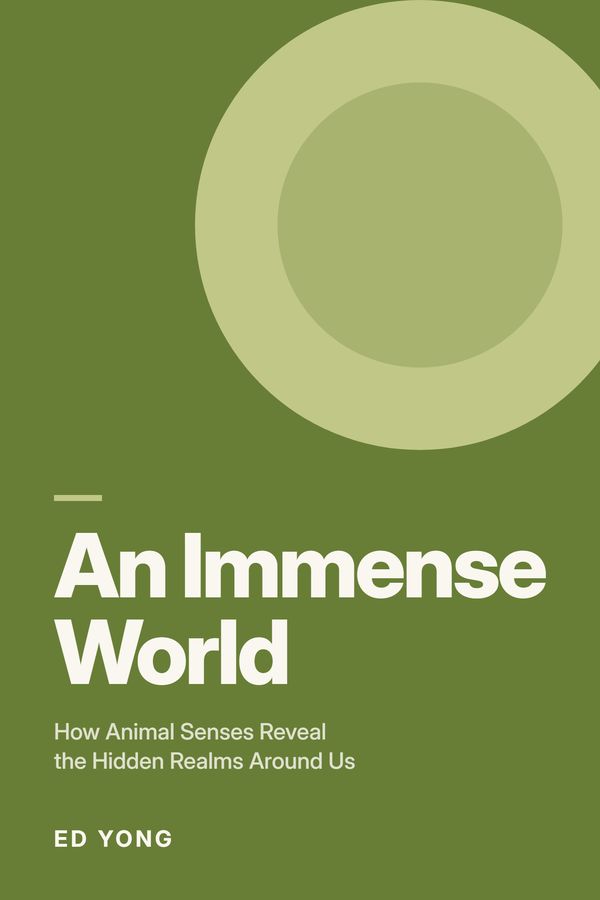
An Immense World summary
How Animal Senses Reveal the Hidden Realms Around Us
The book in one sentence
Every animal, including us, is locked inside its own narrow slice of reality, and learning how other creatures sense the world lets us imagine lives far stranger than our own.
Overview
Ed Yong takes you inside the senses of animals, from dogs that smell in stereo to sea turtles that read the Earth's magnetic field. The point is simple and humbling: the world you notice is only a sliver of what is really out there, and every creature catches a different piece.
Key idea 1: Every Animal Lives in a Bubble
Imagine a room full of animals: a person, a bat, a snake, a bee, a dog. A phone rings and a candle burns. Each creature notices a completely different set of things. The scientist Jakob von Uexkull had a word for the private world an animal senses: the Umwelt. It comes from the German for 'environment,' but he meant something tighter, the thin slice of the world a creature can actually pick up.
His favorite example was the tick. A tick, blind and deaf, runs its whole life on three cues. It smells butyric acid, a chemical that wafts off mammal skin, and drops from its perch. It feels the warmth of a body and crawls toward it. It touches bare skin and bites. That is nearly the tick's entire reality. A birdsong, the color of your shirt, none of it exists for the tick. Its world is complete for a tick. It holds exactly what a tick needs and nothing extra.
Yong's point is that we are all ticks. Your Umwelt feels like the whole of reality because it is the only one you have ever had. But you cannot hear what a mouse hears or feel the magnetic pull a robin senses. The philosopher Thomas Nagel once asked what it is like to be a bat, and his honest answer was that we can never fully know. A bat's experience is built from senses we do not own.
The gift of the idea is a kind of humility. Once you accept that your senses hand you an edited version of the world, other animals stop looking dumb or limited. They are simply tuned to a different station. To use this, try catching your own filter in the act. Right now there are radio waves passing through your body and sounds too high for your ears to catch. You are missing almost everything, and so is every creature beside you. That missing piece is where the book lives.
7 more key ideas in the app
- 2. There Is No Best Sense
- 3. Smell Is the Oldest Language
- 4. More Color Receptors, Same Old Problem
- 5. Seeing Heat, Feeling Harm
- 6. The World Comes Through Touch
- 7. Senses We Have No Word For
- 8. We Are Drowning Out the Signal
Did you know?
- Ed Yong won a Pulitzer Prize in 2021 for his reporting on the COVID pandemic at The Atlantic, the year before this book came out.
- This is Yong's second book. His first, 'I Contain Multitudes,' explored the hidden world of microbes that live in and on animals.
 Astrophysics for People in a Hurry
 Braiding Sweetgrass
 Brief Answers to the Big Questions
 Chaos
 Collapse