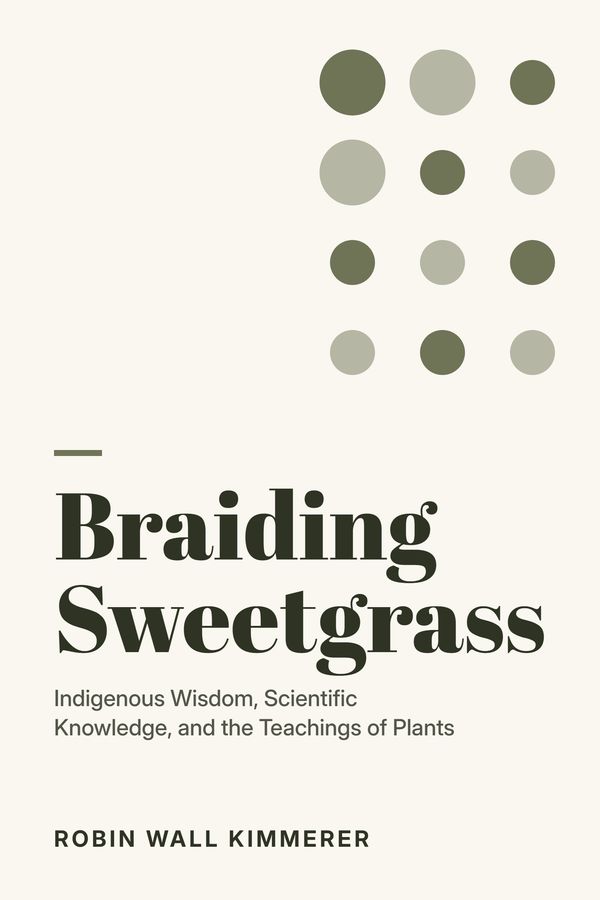
Braiding Sweetgrass summary
Indigenous Wisdom, Scientific Knowledge, and the Teachings of Plants
The book in one sentence
Kimmerer argues that the earth treats us as kin and hands us its gifts freely, and that our part of the bargain is to answer with gratitude and care, taking only what we need and giving something back.
Overview
Robin Wall Kimmerer is a botanist and a member of the Potawatomi Nation, and here she weaves plant science together with the Native teachings she grew up in. She asks a plain question with real weight: what would change if we treated the earth as a gift and a relative instead of a pile of resources to spend?
Key idea 1: The First Story Sets the Rules
Kimmerer opens with an old Skywoman story from the Haudenosaunee and Anishinaabe peoples. A woman falls through a hole in the Skyworld, tumbling down toward an ocean with no land in sight. Geese fly up and catch her on their wings. The water animals see she cannot swim or fly, so they try to help her. One after another dives to the dark bottom to bring up mud, and it is the humble muskrat, the weakest one, who finally reaches it and dies with a handful of earth in his paw. A turtle offers his broad back. Skywoman spreads the mud there and dances her thanks, and the mud grows into the whole land we now call Turtle Island. She had fallen with seeds and plants clutched in her hand, so she scatters them, and the world turns green. Kimmerer sets this beside the garden story many of us grew up with. In that one, the first woman eats fruit she was told to leave alone and gets sent out of paradise, and her children inherit the job of taming a hard world. The point she draws is simple. The stories a people carry teach them how to stand on the land. Skywoman arrives as a guest who is cared for by animals and who gives back by planting, so people raised on her story tend to see themselves as partners with the living world. A story of banishment teaches something colder, that people and nature were split apart at the very start, and that the earth is here mainly to be used. Kimmerer is not asking anyone to swap religions. She is pointing out that we act out the tales we are told, mostly without noticing. If your oldest story says you were thrown out of the garden, you may spend your life fighting the ground. If it says a grateful woman danced a continent into being with the help of a dying muskrat, you may go looking for ways to give back. She invites us to notice which story is running quietly under our choices.
7 more key ideas in the app
- 2. Calling a Tree It Changes How You Treat It
- 3. The Three Sisters Grow Better Together
- 4. A Gift Ties You to the Giver
- 5. Rules for Taking Without Taking Too Much
- 6. Sweetgrass Grows Back Stronger When It Is Used
- 7. Gratitude Is the Cure for Always Wanting More
- 8. Starve the Monster of Endless Hunger
Did you know?
- The book came out in 2013 from a small nonprofit press and sold modestly at first. Word of mouth carried it for years, and it climbed onto the New York Times bestseller list around 2020, long after its release.
- Kimmerer is a trained plant ecologist who teaches at the SUNY College of Environmental Science and Forestry in New York. Her earlier book about mosses, Gathering Moss, won the John Burroughs Medal for nature writing.
 Brief Answers to the Big Questions
 Chaos
 Collapse
 Cosmos
 Entangled Life