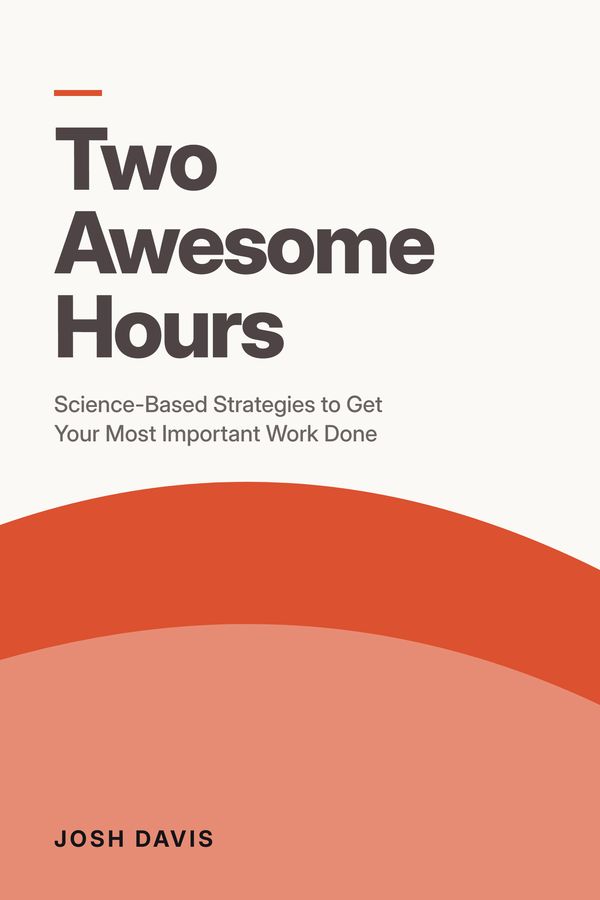
Two Awesome Hours summary
Science-Based Strategies to Get Your Most Important Work Done
The book in one sentence
You cannot be equally productive every hour, so the smart move is to create the right conditions for a couple of highly effective hours on what matters most.
Overview
Most of us try to grind through the whole day and end up doing our best work almost by accident. Josh Davis, a psychologist, says stop chasing all-day output. Set up the conditions for two hours of sharp, focused work, and let the rest of the day be ordinary.
Key idea 1: Stop Running Yourself Like a Machine
We have quietly borrowed the logic of machines and applied it to ourselves. A computer runs the same at nine in the morning as it does at nine at night. It does not get tired or hungry, and it does not care what it worked on an hour ago. So we assume we should be like that too: steady output hour after hour, with no dips. Davis says this belief is the root of most of our frustration. Human brains do not work at a flat rate. They rise and fall depending on sleep, food, mood, and what you just finished doing. When you fight that truth, you feel like you are failing all day long.
His fix is to lower the bar in a useful way. You do not need sixteen good hours. You need about two. If you can set up two hours when your mind is fresh and your focus is real, you can get your most important work done in that window. The rest of the day can go to the ordinary stuff that fills most jobs, like email and meetings that do not need your peak brain.
The words 'set up' matter here. Davis does not promise a trick that makes you brilliant on command. He promises something smaller: you can build the conditions that make a great stretch of work likely. Think of a good athlete before a race. They cannot control whether they win, but they control their sleep and warm-up so their best is ready when it counts. You can do the same with mental work.
This changes how you judge a day. Instead of asking 'was I busy from morning to night,' you ask 'did I protect two hours for the work that actually moves things forward.' Most people never protect that window. They let it get chewed up by whatever lands in front of them, then do their real work late at night on fumes. The reframe is simple to say and hard to live: give up the fantasy of constant output, and start guarding a small slice of time you can actually make great.
7 more key ideas in the app
- 2. Recognize Your Decision Points
- 3. The Real Cost of Self-Control
- 4. Use Your Emotions, Do Not Mute Them
- 5. Stop Fighting Distraction, Let the Mind Wander
- 6. Move Your Body to Set Up Your Brain
- 7. Eat and Drink for the Next Two Hours
- 8. Shape the Room Around You
Did you know?
- Josh Davis earned his PhD in psychology from Columbia University and worked as director of research at the NeuroLeadership Institute, where he studied how brain science applies to work.
- The book pushes back on the idea that people should run like machines at a steady pace all day. Its title points to setting up the conditions for roughly two highly effective hours rather than trying to optimize every hour.
 When
 Willpower
 168 Hours
 Building a Second Brain
 Deep Work