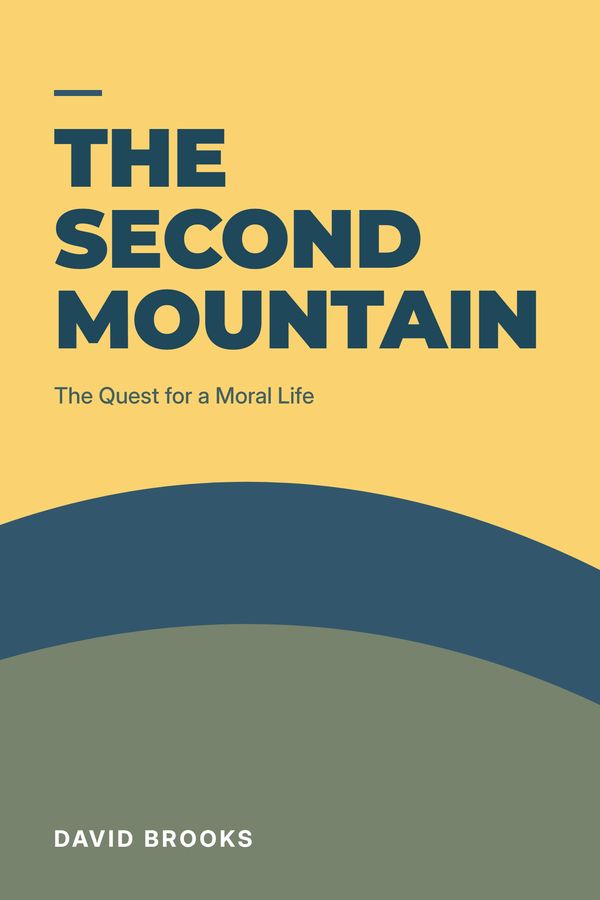
The Second Mountain summary
The Quest for a Moral Life
The book in one sentence
A meaningful life comes not from the first mountain of ego and personal success but from a second mountain built on four deep commitments, to a vocation, a spouse, a faith, and a community, where self-forgetting service produces lasting joy.
Overview
David Brooks says most of us climb two mountains in life. The first is about building a self: career, status, and personal happiness. But that never fully satisfies. The second mountain is about giving that self away to other people, a calling, a faith. That is where deep joy lives.
Key idea 1: The Two Mountains
Brooks builds the whole book on one picture. Early in life, most of us set off to climb a first mountain. The goals on it are the ones our culture hands us: get a good job, build a reputation, make money, be independent, be happy. These are ego goals. They are about the self, about what you can achieve and what people think of you. There is nothing evil about them. Climbing the first mountain is a normal, even healthy, part of growing up.
The problem is what happens at the top. Some people reach their first-mountain goals and feel a strange letdown. They got the promotion, the house, the applause, and still something is missing. Others get knocked off the mountain by a failure or a loss before they reach the peak. Either way, they come to see that the first mountain was never the real journey.
Then comes the second mountain. Its goals are the opposite. Instead of asking what the world can give you, you ask what you can give the world. Instead of building up the self, you commit yourself to things bigger than the self: a spouse, a cause, a faith, a community. First-mountain people are focused on acquiring. Second-mountain people are focused on contributing and belonging.
Brooks uses himself as the example. He admits he spent decades as a successful first-mountain man, good at his career and bad at relationships, and that a painful stretch of loneliness forced him to rethink everything. That honesty is the point. He is not preaching down at you. He is describing a road he had to walk.
The practical lesson is to notice which mountain you are on. If you feel restless even though your life looks good on paper, that is often the signal that first-mountain success has run out of road. The nuance is that the second mountain is not a rejection of the first. You still need a self before you can give it away. The two mountains come in order, and the second one only makes sense once you have climbed the first far enough to see its limits.
7 more key ideas in the app
- 2. The Valley Where You Get Broken Open
- 3. Hyper-Individualism Left Us Lonely
- 4. Happiness Fades, Joy Lasts
- 5. A Vocation Is A Calling, Not A Career
- 6. Marriage As Your Biggest Commitment
- 7. Community And Putting Down Roots
- 8. Faith And Deciding What You Believe
Did you know?
- The Second Mountain was published in 2019 by David Brooks, a longtime New York Times columnist.
- The book is organized around four core commitments: to a vocation, a spouse and family, a philosophy or faith, and a community.
- Brooks contrasts happiness, which is fleeting and self-centered, with joy, which comes from self-forgetting service to others.
 Wintering
 Authentic Happiness
 Before Happiness
 Better Than Before
 Big Potential