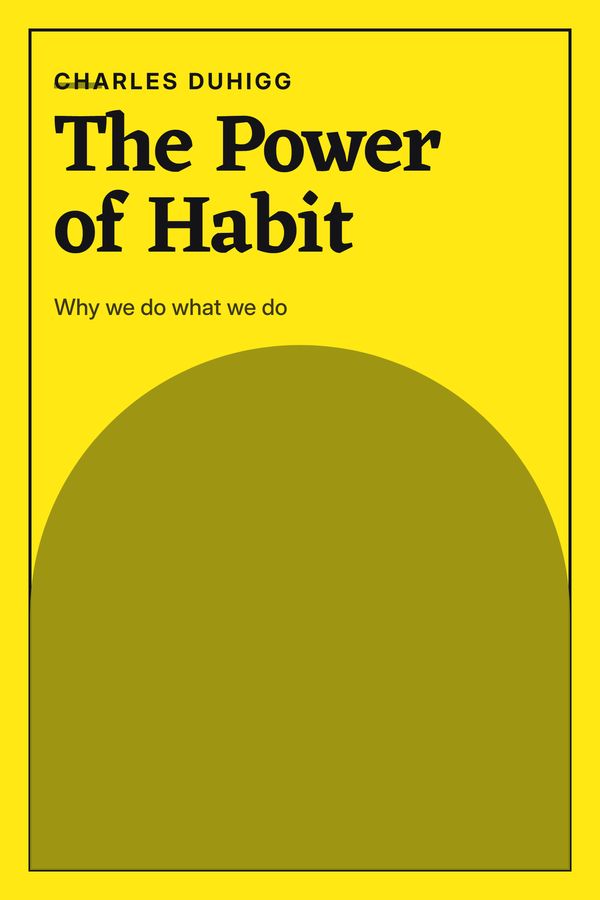
The Power of Habit summary
Why we do what we do
The book in one sentence
Habits run on a cue-routine-reward loop; change the routine while keeping cue and reward to transform behavior.
Overview
Charles Duhigg shows that much of what you do every day runs on habit, not real decisions. He breaks each habit into a loop of cue, routine, and reward, and explains why you can't erase a habit but you can reroute it. Understand the loop and you can change almost anything.
Key idea 1: The Habit Loop Explained
At the core of every habit is a simple three-part loop. First comes the cue, a trigger that tells your brain to go on autopilot and which routine to run. Then the routine itself, the behavior you actually carry out. Last comes the reward, which helps your brain decide whether this particular loop is worth saving for the future. As a behavior repeats, the cue and the reward bind together until the loop runs with almost no conscious thought at all.
Duhigg builds this idea from the strange case of a man he calls Eugene, who lost his memory to a brain infection. Eugene could not say where the kitchen was, yet every day he walked straight to it and made himself a snack. He could not learn new facts, but his brain could still form habits, because habits live in an older, deeper part of the brain than memory does. That is why you can drive all the way home and barely recall the trip, or reach for your phone the second you feel a flicker of boredom.
The brain does this on purpose. Turning a routine into a habit lets it power down and save effort for everything else. But that same efficiency has a cost. Habits never fully disappear. They are carved into the brain, sitting quietly, ready to fire the instant their cue shows up again. This is why people who quit smoking for years can be ambushed by a craving the moment they catch a familiar smell.
To use this, start by playing detective on a habit you want to change. Watch for the exact cue that kicks it off and the reward that closes it out. Write them down for a few days until the pattern is obvious. You cannot change a loop you cannot see.
The nuance worth keeping is that you should not expect the loop to ever vanish. The realistic goal is not erasing it but understanding it. Once you can name the cue that starts a routine and the reward that ends it, the habit stops feeling like a mystery you are at the mercy of and starts looking like a machine you can take apart and rebuild.
7 more key ideas in the app
- 2. Cravings Drive the Loop
- 3. The Golden Rule of Change
- 4. Diagnose the Real Reward
- 5. Keystone Habits Trigger Change
- 6. Willpower Is a Muscle
- 7. Belief Makes Change Last
- 8. Once You See It, You Own It
Did you know?
- Duhigg reports that one study found about 40 percent of the actions people take each day are not real decisions but habits running on their own.
- Target's analysts once built a pregnancy prediction model from shopping habits so accurate it figured out a teenage customer was pregnant before her own father did.
Featured in: How to Create Habits, Modern Classics, Eliminate time-wasters (guide), Build unstoppable habits (guide)
 The Power of Positive Thinking
 The Power of Your Subconscious Mind
 The Rise of Superman
 The Slight Edge
 The Subtle Art of Not Giving a F*ck