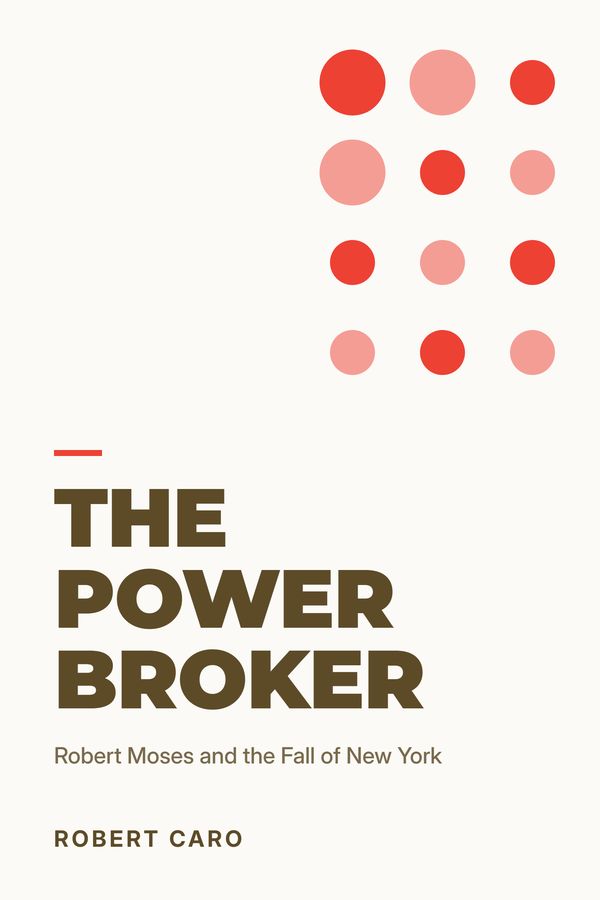
The Power Broker summary
Robert Moses and the Fall of New York
The book in one sentence
Robert Moses shows how one unelected man can gather enough power to remake a whole city, and how holding that much power reveals the person underneath.
Overview
For more than forty years, Robert Moses built the bridges and parks of New York without ever winning an election. Robert Caro spent seven years working out how one man got the power to pour that much concrete, and what it cost the city and the people in his way.
Key idea 1: The Man Who Never Won an Election
Robert Moses never held an elected office that mattered. He ran for governor once, in 1934, and lost by a wide margin. Yet from the 1920s into the 1960s he had more real power over New York than most governors and mayors who did win their seats. He put up 13 bridges and laid 416 miles of parkway. He opened 658 playgrounds and shaped where whole neighborhoods lived and how they got to work. Caro's first question is a simple one: how did a man with no votes behind him get so strong?
The short answer is that Moses found sources of power that did not depend on elections. He held many appointed jobs at the same time, sometimes as many as twelve. He was Parks Commissioner for the city and the head of parks for the whole state. He ran the agency that built the bridges and collected the tolls. Each job gave him a piece of control, and he stacked them so that prying one loose did not bring the rest down.
He also made himself the one man who could actually get things built. Politicians wanted ribbons to cut and projects to point at. Moses delivered them, on schedule, with his name on the plans. That made governors and mayors need him more than he needed them. When they crossed him, he would threaten to quit in public, and the papers treated it as a crisis. He knew they could not afford to lose the only person who knew how to move the dirt.
There is a warning here for anyone who thinks power sits only in the top job. It often lives in the quiet roles: the one who controls the money or holds a skill nobody else has. Moses saw that early and spent his life collecting those roles rather than chasing the spotlight of office. A vote is only one kind of power, and often not the strongest kind.
To use this idea, look past the org chart when you want to understand who really decides something. Ask who holds the budget, and who can say no and make it stick. You will often find that the loudest title is not the one running the room.
7 more key ideas in the app
- 2. The Public Authority Was His Machine
- 3. From Bright Reformer to Ruthless Builder
- 4. Get the Stake in the Ground
- 5. He Built a City for Cars
- 6. The Meat Ax and the People It Hit
- 7. He Wrote His Own Legend
- 8. How the Power Ended
Did you know?
- Robert Caro worked on the book for about seven years, and money got so tight that his family nearly went broke before he finished. His editor then cut roughly 350,000 words, and even so it runs well over 1,200 pages.
- The Power Broker won the Pulitzer Prize for Biography in 1975. Robert Moses, by then in his eighties, fought back with a long public statement calling it full of errors, but Caro's account became the one people trust.
 The Ride of a Lifetime
 The Wright Brothers
 Titan
 Total Recall
 Truman