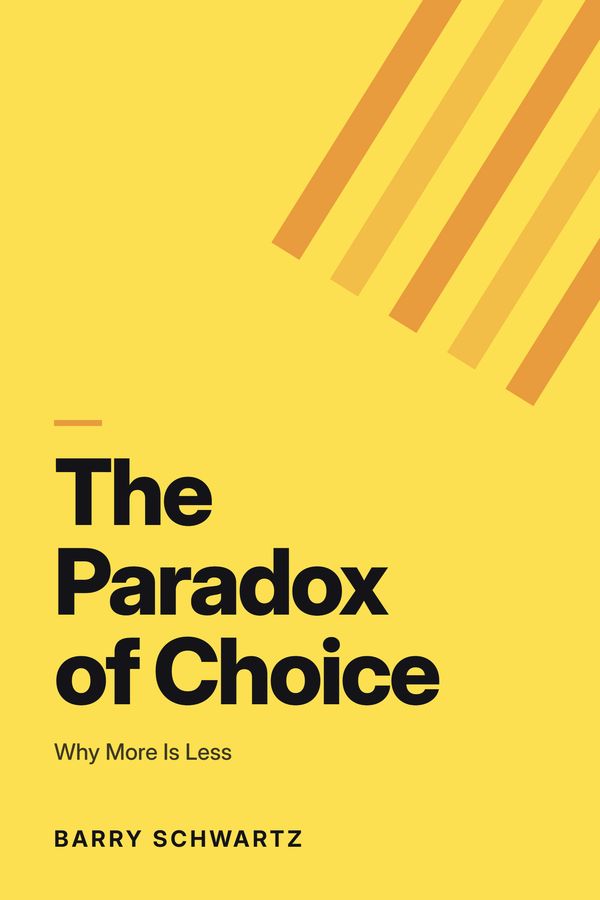
The Paradox of Choice summary
Why More Is Less
The book in one sentence
Endless options were supposed to set us free, but they leave us paralyzed, second-guessing, and less happy, so learn to limit choices, settle for good enough, and commit to what you pick.
Overview
Barry Schwartz shows that all the freedom of modern life, with its endless options, is quietly making us miserable. When everything is on the table, we freeze, second-guess ourselves, and end up less happy with whatever we pick. This book explains why more turns into less, and how to choose in a way that feels good.
Key idea 1: When More Options Freeze You
We treat choice like a pure good. More options should mean more freedom, and more freedom should mean more happiness. Schwartz argues that this breaks down fast. Past a certain point, adding choices does not free you. It paralyzes you and drains the joy out of picking anything at all.
The clearest proof is a study run by psychologist Sheena Iyengar in a fancy grocery store. She set up a table where shoppers could taste jam. Some days the table held 24 different jams. Other days it held only 6. The big display pulled in more curious people, which is what you would expect. But then came the twist. Of the shoppers who saw 24 jams, only about 3 percent actually bought a jar. Of the shoppers who saw just 6 jams, about 30 percent bought one. The smaller display sold ten times better. Too many options did not tempt people. It shut them down.
This happens because every added option raises the mental cost of choosing. With six jams you can weigh them and decide. With 24, the comparing never ends, the fear of picking wrong grows, and walking away feels easier than sorting it all out. Schwartz saw the same effect in serious matters, like workers who were less likely to join a retirement plan when the plan offered more fund choices, even though joining meant free money from the employer.
To use this, notice where an overload of options is quietly stopping you, and shrink the field on purpose. If you have 40 tabs open comparing laptops, force yourself down to three that clear your basic bar, then choose among only those. A smaller set is not a worse decision. It is often the only way you will decide at all.
The nuance is that some choice is far better than none. Schwartz is not against options. He is pointing out that the curve turns. A few good choices make life richer. A flood of them makes life heavier, and the heaviness is real even when the extra options look like a gift.
7 more key ideas in the app
- 2. Maximizers and Satisficers
- 3. The Hidden Cost of Every Choice
- 4. The Weight of Regret
- 5. Why the Thrill Fades
- 6. The Trap of Rising Expectations
- 7. When Bad Choices Become Self-Blame
- 8. How to Choose and Stay Happy
Did you know?
- The Paradox of Choice was published in 2004 by psychologist Barry Schwartz.
- Its central jam study, run by Sheena Iyengar, found shoppers were ten times more likely to buy from a display of 6 jams than one of 24.
- Schwartz divides people into maximizers, who seek the best option, and satisficers, who settle for good enough.
 The Righteous Mind
 The Social Animal
 The Undoing Project
 Thinking in Bets
 Thinking, Fast and Slow