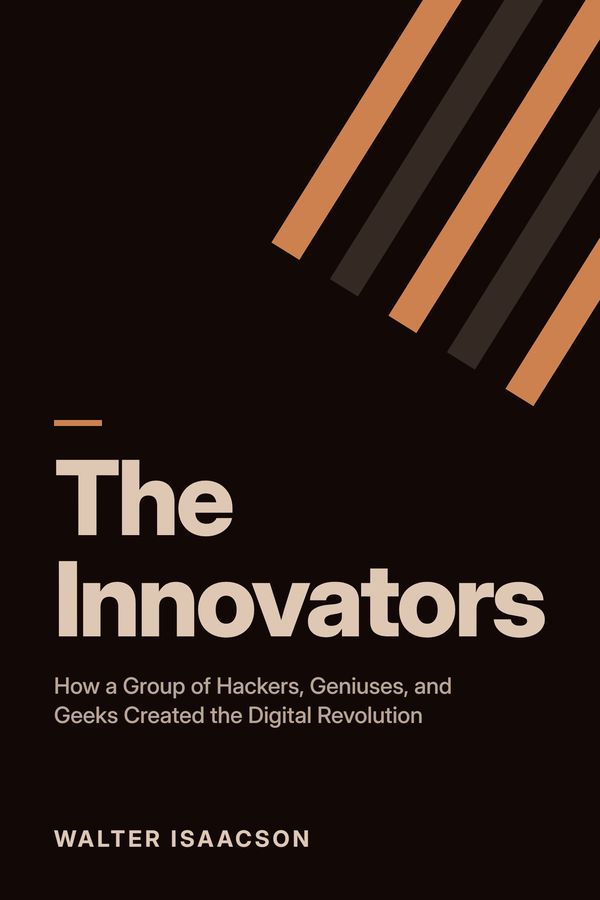
The Innovators summary
How a Group of Hackers, Geniuses, and Geeks Created the Digital Revolution
The book in one sentence
The digital revolution was driven not by lone geniuses but by collaboration, as visionaries, engineers, and tinkerers across generations combined their ideas to build the computer and the internet.
Overview
Isaacson tells the story of the digital age, and it is not a tale of lone geniuses in garages. It is a story of teams. From Ada Lovelace to the internet, the big leaps came when visionaries, engineers, and tinkerers found each other and built things none of them could have made alone.
Key idea 1: Innovation Is a Team Sport
We love the story of the lone genius. One brilliant person has a flash of insight in a quiet room, and the world changes. Isaacson spent years studying the people who built the computer and the internet, and he found that this story is mostly a myth. The real engine of the digital age was collaboration. The great leaps happened when people with different gifts found each other and worked side by side.
His argument is simple. Big ideas need more than one kind of mind. You need a visionary who can imagine what does not exist yet. You need an engineer who can actually build it. You need people who understand the market and people who care only about the science. Rarely does all of that live in one head. So the inventions that stuck came from partnerships and teams, not solo acts.
Take the transistor, one of the most important inventions of the century. It came out of Bell Labs, a place built to throw theorists, experimenters, and practical tinkerers into the same hallways. Three very different men, John Bardeen, Walter Brattain, and William Shockley, produced it together, and each supplied something the others lacked. The same pattern shows up again and again through the book, from the first computers to the founding of the web.
To use this idea, stop waiting for a single perfect founder or a lightning bolt of personal genius. If you want to build something new, build a team that mixes the dreamer with the doer. Put people who think differently in close contact and let them rub against each other.
The nuance is that individuals still matter. Isaacson is not saying people are interchangeable. Ada Lovelace, Alan Turing, and Steve Jobs were singular. His point is that even these standout figures did their best work by connecting to others, borrowing ideas, and adding their piece to a shared effort. Genius sparks the fire, but collaboration keeps it burning.
7 more key ideas in the app
- 2. Ada Lovelace and Poetical Science
- 3. The Computer Had Many Parents
- 4. Bell Labs and the Power of Proximity
- 5. The Overlooked Women Who Wrote the Code
- 6. The Microchip and the Open Culture of the West
- 7. Making the Computer Personal
- 8. Machines That Partner With People
Did you know?
- The Innovators was published in 2014 by Walter Isaacson, who also wrote bestselling biographies of Steve Jobs, Albert Einstein, and Benjamin Franklin.
- Ada Lovelace, the daughter of the poet Lord Byron, wrote what many consider the first computer program in 1843, in her notes on Charles Babbage's Analytical Engine.
- A 1973 court ruling voided the ENIAC patent, finding that key ideas traced back to John Atanasoff's earlier work in Iowa.
 The Making of the Atomic Bomb
 The Man Who Knew Infinity
 The Order of Time
 The Selfish Gene
 The Sixth Extinction