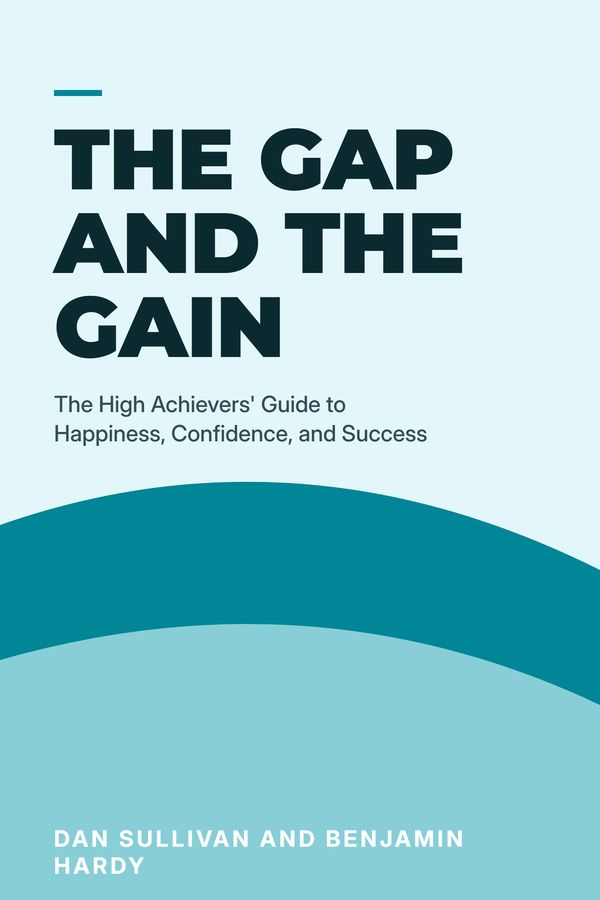
The Gap and the Gain summary
The High Achievers' Guide to Happiness, Confidence, and Success
The book in one sentence
How happy you feel comes down to what you measure your life against, so measure it against where you started instead of against an ideal you can never reach.
Overview
Dan Sullivan spent decades coaching successful entrepreneurs and kept meeting the same puzzle: people who had won big still felt like they were losing. This book names the reason. You can measure your life against an ideal you will never reach, or against how far you have actually come, and that choice decides how you feel.
Key idea 1: Two Ways to Measure Your Life
Dan Sullivan noticed something odd after years of coaching entrepreneurs. People who had built great companies and made a lot of money still felt behind. They had a picture in their head of where they should be, and they kept holding their real life up against it. That picture is what Sullivan calls the ideal. When you measure the distance between where you are now and that ideal, you land in the Gap. And the Gap always feels bad, because the ideal is not a real place you can stand. It works like the horizon. You can walk toward it all day and it stays the same distance away. The Gain is the other way to measure. Instead of looking forward at the ideal, you look back at where you started. You measure the distance you have actually covered. That distance is real. You can point to it. A year ago you could not do the thing you do easily now. Six months ago you did not know the people you know now. When you measure back against your former self, you see progress, and progress feels good. Here is the key point of the whole book. Nothing about your situation has to change for your happiness to change. Two people can have the exact same job and the same house. One measures against the ideal and feels like a failure. The other measures against where they began and feels proud. The facts are identical. The reference point is different, and the reference point is what you feel. The ideal still has a use. It points you in a direction, the way the horizon tells a sailor which way is west. The trouble starts when you treat the horizon as a place you were supposed to arrive at by now. You will always fall short of it, by design, forever. So Sullivan's rule is simple: use the ideal to steer, but never use it to measure how you are doing. Save the measuring for the Gain, where the numbers are real and the progress is yours to keep.
7 more key ideas in the app
- 2. Why Winning More Never Fills the Hole
- 3. Always Measure Backward
- 4. The Bronze Medalist Is Happier Than the Silver
- 5. Turn Every Experience Into a Gain
- 6. Gratitude Pulls You Out of the Gap
- 7. Stop Measuring Against Other People
- 8. End Every Day in the Gain
Did you know?
- The Gap and the Gain grew out of Dan Sullivan's Strategic Coach program, which he started in 1989 and has used to coach tens of thousands of entrepreneurs. It is his second book with Benjamin Hardy, after their 2020 book Who Not How.
- Benjamin Hardy is an organizational psychologist who built a huge online following as a writer before turning to books. The claim the book uses that bronze medalists often seem happier than silver medalists comes from real research on the faces of Olympic athletes.
 The Happiness Advantage
 The Kybalion
 The Life-Changing Magic of Tidying Up
 The Magic of Thinking Big
 The Master Key System