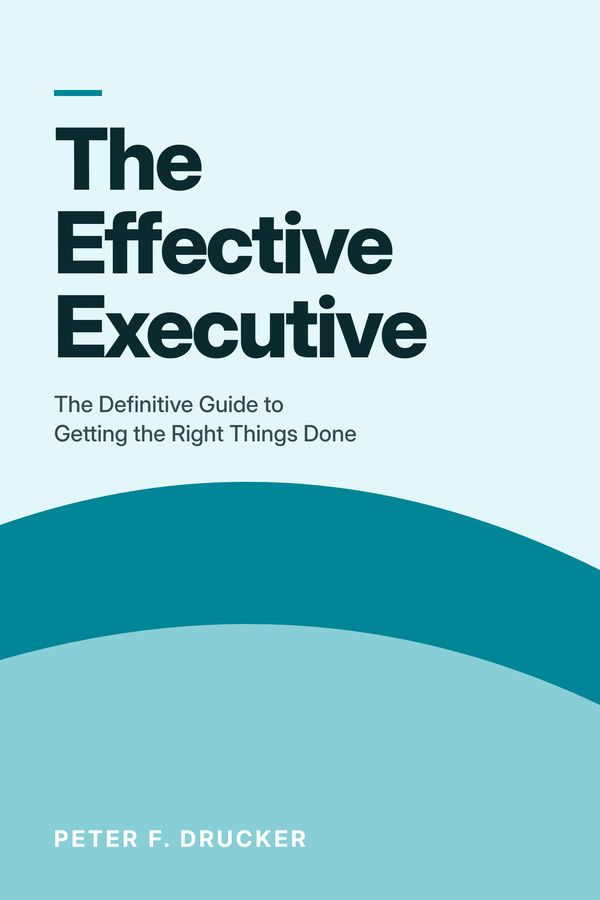
The Effective Executive summary
The Definitive Guide to Getting the Right Things Done
The book in one sentence
Effectiveness is a set of learnable habits: managing your time, aiming at contribution, building on strengths, concentrating on the few things that matter, and making sound decisions.
Overview
Peter Drucker had a plain claim: effectiveness is not a gift you are born with. It is a habit, a set of practices anyone can learn. This book shows how the best executives manage their time, aim at real results, and make decisions that actually stick.
Key idea 1: Effectiveness Can Be Learned
Drucker starts by knocking down a myth. We tend to think some people are just born effective, blessed with brains, charm, or drive that lets them get things done. He watched executives for decades and found the opposite. The most brilliant people were often the least effective, while steady, ordinary plodders frequently ran circles around them. Intelligence, imagination, and knowledge are real resources, but on their own they produce nothing. Only effectiveness turns them into results.
The good news follows fast. If effectiveness were a talent, we'd be stuck with whatever we were handed at birth. But Drucker argues it is a habit, a set of practices, and like any set of practices it can be learned by anyone willing to work at it. He compares it to the multiplication tables. You drill it until it becomes automatic, until you do the right things without straining to remember them.
Why does this matter so much now? Drucker points to a new kind of worker he helped name: the knowledge worker. A factory worker's output can be measured and supervised. A knowledge worker's output is ideas, information, and decisions, and nobody can stand over their shoulder and check the thinking. Their work only becomes useful when someone else picks it up and acts on it. So the knowledge worker has to manage themselves. If they aim at the wrong target, no amount of effort saves them.
To put this into practice, stop waiting to feel effective and start building the habits. Drucker lays out five: manage your time, aim at contribution, build on strengths, concentrate on the few things that matter, and make sound decisions. None require genius. Each is a practice you repeat until it sticks.
The nuance worth holding on to is that being busy is not the same as being effective. Plenty of hardworking people pour energy into tasks that don't matter and call it a full day. Drucker's whole book is about doing the right things, not just doing things right. Effort measures input. Effectiveness measures output. Only one of them shows up in results.
7 more key ideas in the app
- 2. Know Where Your Time Goes
- 3. Aim For Contribution
- 4. Build On Strengths
- 5. First Things First
- 6. Find The Right Question First
- 7. Decisions Need Disagreement
- 8. A Decision Isn't Done Until It's Action
Did you know?
- Peter Drucker was born in Vienna in 1909 and wrote 39 books across his career. He is widely called the father of modern management and kept working almost until his death in 2005.
- The Effective Executive was first published in 1966 and has never gone out of print. It is often cited as one of the few management books that focuses on the individual rather than the organization.
- Drucker coined the term knowledge worker in the late 1950s, before this book, to describe people who work mainly with information and ideas rather than their hands.
 The First 20 Hours
 The Miracle Morning
 The Now Habit
 The One Minute Manager
 The ONE Thing