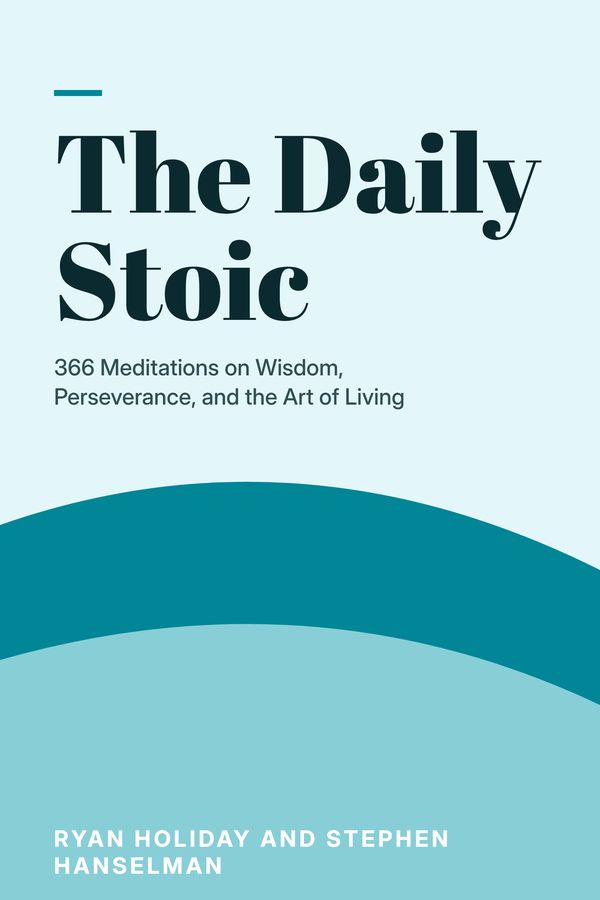
The Daily Stoic summary
366 Meditations on Wisdom, Perseverance, and the Art of Living
The book in one sentence
A calm, effective life comes from focusing only on what you control, choosing your judgments about events, and practicing Stoic wisdom in small daily reflections.
Overview
Two thousand years ago, a handful of Greeks and Romans worked out how to stay calm and act well no matter what life threw at them. Ryan Holiday and Stephen Hanselman pull that wisdom into 366 short daily lessons. This is the core of what those old thinkers actually taught.
Key idea 1: Sort What You Control
The Stoics start with one idea that runs under everything else: some things are up to you, and some are not. Epictetus, a former slave who became one of the most quoted teachers in the book, opens his own writing with this. Your choices, your effort, your judgments, and how you respond are yours. The weather, other people's opinions, your reputation, whether you get the job, whether you get sick, none of that is fully in your hands.
Most of our stress comes from mixing these two piles up. We pour worry into things we cannot move and then feel helpless. We tie our peace of mind to a promotion or a person's approval, and when it does not go our way, we fall apart. The Stoics would say the problem is not the event. The problem is that we bet our happiness on something outside our control.
Holiday gives a plain example that fits modern life. Say your flight gets canceled. The cancellation is not up to you. Fuming at the gate agent, refreshing the app, and cursing the airline changes nothing and ruins your mood. What is up to you is how you use the delay. You can read, call someone you love, or rebook calmly. Same event, two completely different experiences, and the only variable is where you put your attention.
To use this, get in the habit of asking one question when something upsets you: is this actually up to me? If yes, get to work on it. If no, let it go and turn to your response, which always is up to you. This is not giving up. It is aiming your energy where it can do real good instead of wasting it.
A common mistake is thinking Stoics want you to control nothing and just accept everything. It is the reverse. They want you to fully own the small circle that is truly yours, your own actions and reactions, and stop leaking effort into the huge world you cannot command. Master that split, and a lot of anxiety simply dries up.
7 more key ideas in the app
- 2. You Choose The Story
- 3. Remember You Will Die
- 4. The Obstacle Is The Way
- 5. Rehearse The Bad In Advance
- 6. Bookend Your Day
- 7. Build Character, Not Image
- 8. Live Right Now
Did you know?
- The book is organized as 366 daily readings, one for each day of the year including leap day.
- It draws mainly on three Stoics: Marcus Aurelius, a Roman emperor, Seneca, a wealthy statesman and writer, and Epictetus, a former slave turned teacher.
- Marcus Aurelius never meant his Meditations for publication; they were private notes he wrote to himself.
Featured in: Stoic Essentials, Live like a stoic (guide)
 The Enchiridion
 The Genealogy of Morals
 The Myth of Sisyphus
 The Nicomachean Good Life
 The Obstacle Is the Way