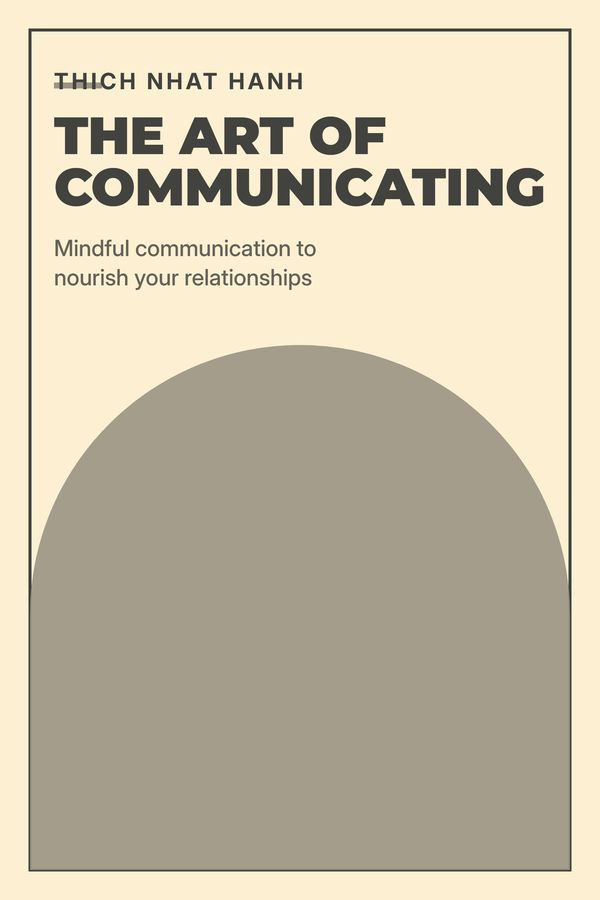
The Art of Communicating summary
Mindful communication to nourish your relationships
The book in one sentence
Our words are a kind of food, and by coming home to ourselves, listening to ease suffering, and speaking the truth kindly, we can heal our relationships instead of harming them.
Overview
We treat talking as something we just do, but Thich Nhat Hanh says our words are food. They can nourish the people we love or slowly poison them. This small book teaches a gentler way to connect, one that starts with learning to be present with yourself.
Key idea 1: Communication Is a Kind of Food
Thich Nhat Hanh starts with a simple, strange idea: everything you take in is food, and communication is one of the things you eat. When you read a post, watch a show, or talk with a friend, you are consuming something. Some of it nourishes you and some of it quietly poisons you. The same goes for what you put out into the world. A harsh word feeds the other person something toxic. A kind and honest word feeds them something that heals.
He wants us to notice the energy behind our words. If you speak out of anger, that anger travels into the person listening and grows inside them. If you speak out of understanding, that understanding grows in them instead. Words are never just words. They carry the state of mind that made them.
He points to how long a single sentence can feed a person. A parent snaps at a child in one bad moment and forgets it by dinner. But the child can keep eating that sentence for thirty years, chewing on it, hurt by it again and again. One small piece of toxic food kept feeding them for decades. That is how much weight our everyday words can carry.
So the practice is to watch what you consume and what you produce. Through the day, ask a plain question before you speak or hit send: is this nourishing or is this toxic? And notice what you take in too. The endless arguing online, the gossip, the anxious news. Hanh says much of our unhappiness comes from swallowing toxic communication all day long without ever noticing we are eating it.
Here is the part people get wrong. Nourishing does not mean only sweet. You can tell someone a hard truth and still feed them something healthy, as long as it comes from care instead of anger. And staying silent to avoid a fight is not always kind either, because a swallowed hurt becomes its own kind of poison. What matters is the intention underneath. Speak from a calm and caring place, and even difficult words can nourish.
7 more key ideas in the app
- 2. Come Home to Yourself First
- 3. Turn Off the Radio in Your Head
- 4. Listen to Ease Suffering
- 5. Loving Speech Tells the Truth Kindly
- 6. The Six Mantras of Love
- 7. Question What You Think You See
- 8. Carry It Into the World
Did you know?
- Thich Nhat Hanh was a Vietnamese Zen Buddhist monk, teacher, and peace activist who helped bring mindfulness to the West.
- The book builds on the Buddhist idea of Right Speech, one step of the Noble Eightfold Path.
- Hanh teaches six mantras of loving speech, including 'I am here for you' and 'I suffer, please help.'
 The Art of Gathering
 The Charisma Myth
 The Culture Map
 The Definitive Book of Body Language
 The Fine Art of Small Talk