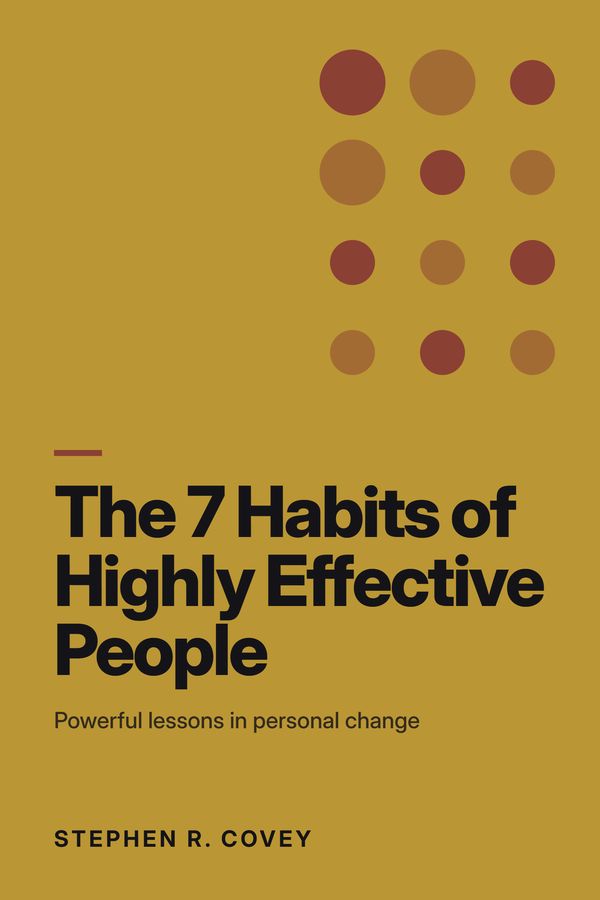
The 7 Habits of Highly Effective People summary
Powerful lessons in personal change
The book in one sentence
Move from dependence to interdependence via private then public victories: be proactive, begin with the end in mind, put first things first, think win-win, seek to understand, synergize, sharpen the saw.
Overview
Stephen Covey argues that real, lasting effectiveness grows from character, not clever personality tricks. His seven habits move you from depending on others, to standing on your own, to working well with people. Change how you see a problem, he says, and you change how you act on it.
Key idea 1: Be Proactive, Not Reactive
The base of Covey's whole framework is that you are responsible for your own life. Being proactive means more than taking initiative. It means accepting that your behavior comes from your own decisions, not your conditions. Reactive people are driven by feelings, circumstances, and how others treat them. A rude comment or grey weather can wreck their whole day. Proactive people carry their own weather and choose their response no matter what is happening around them.
The key insight sits in the gap between what happens to you and how you respond. Covey was deeply shaped by the writing of Viktor Frankl, who survived the Nazi death camps. Stripped of everything, Frankl realized the guards could control his body but not his inner response. In that space between the stimulus and the reaction, he found the last human freedom: the freedom to choose. Covey builds the whole habit on that gap. You may not control what lands on you, but you always control your response, and that is where your power lives.
Covey makes this concrete with two circles. The Circle of Concern holds everything you worry about but mostly cannot touch, like the economy, the news, the past, and other people's choices. The Circle of Influence holds the smaller set of things you can actually affect. Reactive people pour their energy into the Circle of Concern, stewing over what they cannot control, and their real influence shrinks. Proactive people spend their energy inside the Circle of Influence, and over time it grows, because steady action on what you can change tends to expand what you can change.
To apply it, catch your own language for a week. Reactive talk sounds like 'I have to,' 'they make me so angry,' 'there is nothing I can do.' Proactive talk sounds like 'I choose to,' 'I control how I respond,' 'let me look at what I can do.' The words are not just words. They reveal and reinforce which circle you are living in.
The common mistake is waiting for circumstances or other people to change before you act. Proactive people work on themselves and the problem in front of them, and they often find that this is exactly what nudges the bigger situation loose.
7 more key ideas in the app
- 2. Begin With the End in Mind
- 3. Put First Things First
- 4. Think Win-Win, Not Win-Lose
- 5. Seek First to Understand
- 6. Synergize Through Your Differences
- 7. Sharpen the Saw
- 8. Character Over Personality
Did you know?
- The 7 Habits of Highly Effective People has sold more than 40 million copies in over 40 languages, making it one of the best-selling business books ever.
- Covey traced the whole framework to a personal experiment: while writing his doctoral dissertation, he reviewed 200 years of American success writing and found that for the first 150 years it focused on character before it switched to personality and quick fixes.
Featured in: Modern Classics, Self Mastery, Build unstoppable habits (guide), Find your calm (guide), Master yourself (guide)
 The Art of Impossible
 The Champion's Mind
 The Compound Effect
 The Courage to Be Disliked
 The Four Agreements