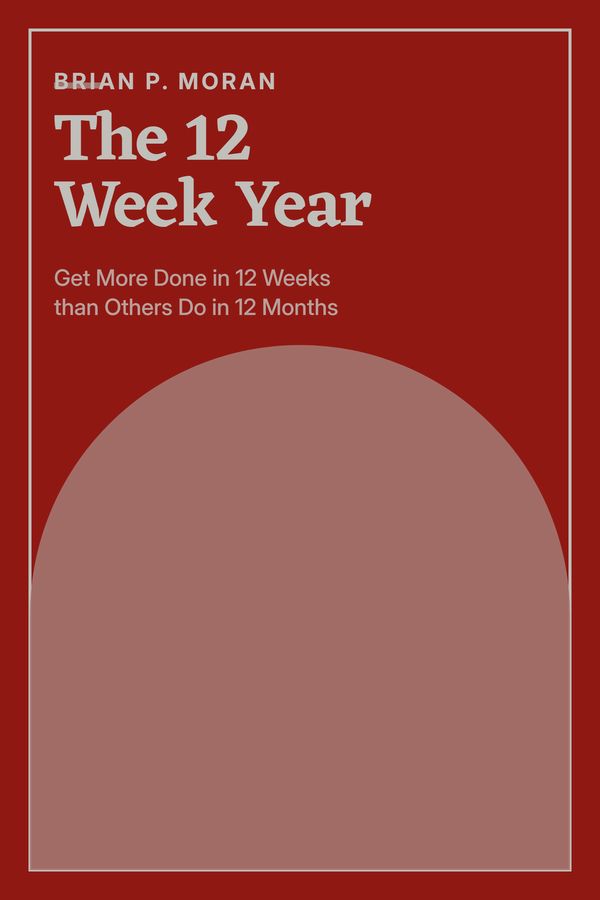
The 12 Week Year summary
Get More Done in 12 Weeks than Others Do in 12 Months
The book in one sentence
By treating every 12 weeks as a full year with only a few focused goals, you keep the deadline close enough to create urgency and get far more done than a slow 12-month calendar ever allows.
Overview
Brian Moran noticed something odd: people get more done in the last few weeks before a deadline than in all the months before it. His fix is to stop thinking in years and start running your life in 12-week blocks, where every week counts and there is no time to coast.
Key idea 1: Make Your Year 12 Weeks Long
The whole book turns on one move: stop treating a year as 12 months and start treating it as 12 weeks. Moran calls this a 12 week year. You pick a short set of goals, give yourself only 12 weeks to hit them, and treat that block as a complete year with its own beginning, middle, and end. When week 12 arrives, that year is over, and a fresh one starts.
The idea comes from sports. Moran points out that athletes train in cycles called periodization, short focused blocks aimed at peaking for a season or an event. A team doesn't spread its effort evenly across 12 lazy months. It concentrates hard work into a defined window and then measures the result. Moran takes that same shape and drops it onto normal work and life goals.
Why does a shorter year help? Because 12 weeks is close enough to see and far enough to matter. You can hold every single week in your mind. You cannot hide a wasted week inside a 12 week span the way you can inside a 12 month one. One bad week out of 12 is a real dent, so you feel it, and you course-correct fast.
To apply this, stop writing goals with a December finish line. Instead, ask what you could accomplish in the next 12 weeks if you were focused. Then set that as your year. Most people find they can do far more in 12 weeks than they expected, because the clock is always visible.
The nuance is that this is not about cramming a year's work into three months. It is about deleting the slow, foggy months where nothing much happens. A normal year has long stretches of drift. A 12 week year has almost none, because the end is never far away. You trade a slow marathon of good intentions for a series of short, sharp sprints, and you finish each one with something real to show.
7 more key ideas in the app
- 2. Kill Annual Thinking
- 3. Start With A Vision You Actually Want
- 4. Write A Simple 12-Week Plan
- 5. Run Your Week As The Game
- 6. Keep Score Every Week
- 7. Own Your Time On Purpose
- 8. Accountability Is Ownership, Not Blame
Did you know?
- The 12 Week Year was written by Brian P. Moran with co-author Michael Lennington, and grew out of Moran's work coaching executives and sales teams on execution.
- The book's core idea borrows from periodization, the training method athletes use to peak in short cycles rather than spreading effort evenly across a full year.
- Moran argues that hitting about 85 percent of your planned weekly actions, not a perfect 100 percent, is usually enough to reach your goals.
 The 4 Disciplines of Execution
 The 4-Hour Workweek
 The 80/20 Principle
 The Bullet Journal Method
 The Checklist Manifesto