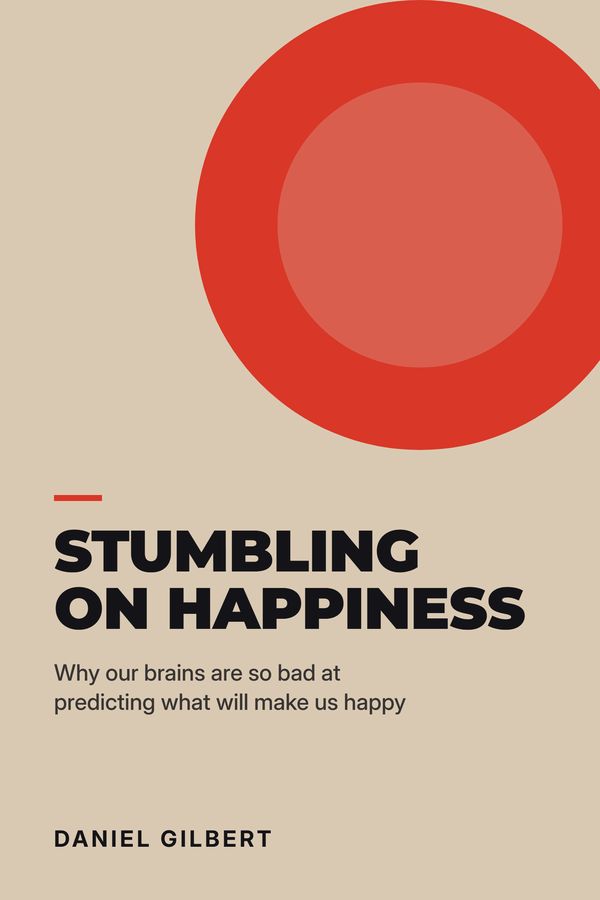
Stumbling on Happiness summary
Why our brains are so bad at predicting what will make us happy
The book in one sentence
Our imagination systematically misjudges what will make us happy, so the smartest way to predict our own future feelings is to distrust our forecasts and study people already living the outcome.
Overview
Harvard psychologist Daniel Gilbert has a simple, unsettling claim: our brains are surprisingly bad at knowing what will make us happy. We predict our own future feelings all day long, and we get them wrong in ways that repeat. This book shows why, and how to guess better.
Key idea 1: Your Mind Is A Time Machine
Gilbert opens with what makes humans strange among animals: we spend a huge share of our waking life thinking about the future. He calls this ability prospection, the mind's habit of leaving the present and mentally visiting a time that has not happened yet. You do it constantly. You picture how a meeting will go, how a slice of cake will taste, how you will feel a year after taking a new job. No other creature does this in the rich, detailed way we do.
He argues the human brain became a planning organ. The frontal lobe, the last big part to evolve, is largely a machine for imagining what comes next. Gilbert points to the strange case of Phineas Gage, a railroad worker whose frontal lobe was destroyed by an iron rod. Gage lived, but he lost the ability to plan and think ahead. He became a man trapped in the present. That damage showed how much of our forward gaze lives in that one region.
Why do we do all this imagining? Mostly to steer. We simulate a possible future so we can decide whether we want it. Should I move to that city? I imagine living there and check how the picture feels. If it feels good, I lean toward it. If it feels bad, I pull back. Our whole sense of what to do rests on these mental previews.
Here is the catch that drives the rest of the book. We treat those previews as accurate. We assume the future we imagine is a fair sample of the future we will get, and that the feelings we predict are the feelings we will have. Both assumptions are shaky.
The practical move is humility about your own forecasts. When you catch yourself sure that some outcome will make you thrilled or miserable, remember that you are running a simulation, not viewing a fact. A common mistake is to trust the vividness of the picture. A clear, gripping image of the future feels true, but clarity is not accuracy.
7 more key ideas in the app
- 2. Imagination Fills In The Blanks
- 3. The Present Colors The Future
- 4. Feelings Fade Faster Than You Think
- 5. You Have A Hidden Immune System
- 6. Memory Is A Rebuild Not A Replay
- 7. Everything Is Judged By Comparison
- 8. Ask Someone Who Is Already There
Did you know?
- Daniel Gilbert is a professor of psychology at Harvard, and the field he studies, how people predict and mismeasure their own future feelings, is called affective forecasting.
- Stumbling on Happiness won the 2007 Royal Society Prize for Science Books and became a New York Times bestseller.
- The book draws on the case of Phineas Gage, whose frontal lobe injury from an iron rod stripped away his ability to plan ahead.
Featured in: Happiness Blueprint
 Stumbling Toward Enlightenment
 The Antidote
 The Art of Happiness
 The Art of Making Memories
 The Blue Zones of Happiness