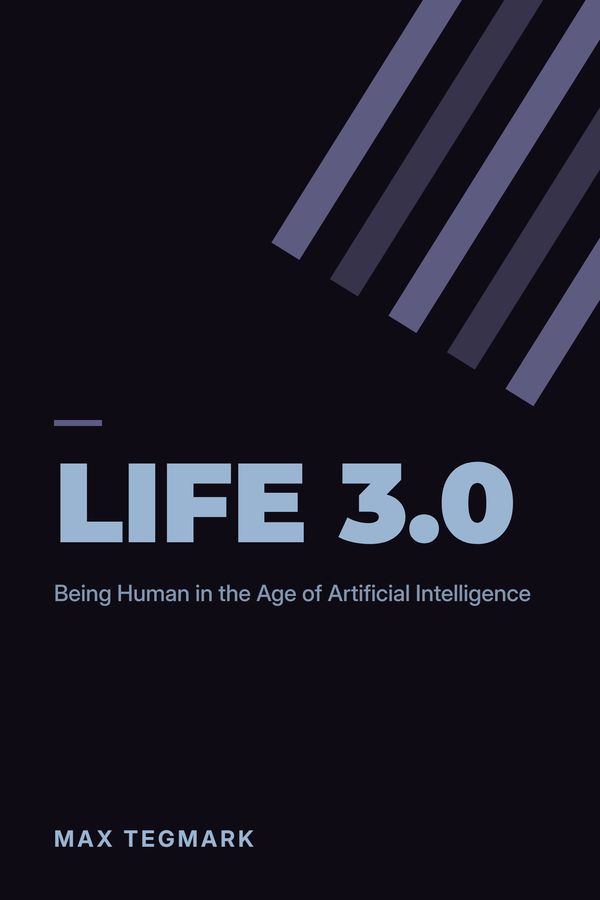
Life 3.0 summary
Being Human in the Age of Artificial Intelligence
The book in one sentence
Tegmark reframes AI as the possible birth of a new kind of life that can redesign its own body and mind, and argues that whether it brings paradise or ruin depends on the unsolved work of aligning its goals with human values, work we must steer now rather than race past.
Overview
What happens to us when machines can out-think humans at everything? MIT physicist Max Tegmark asks the biggest question of our century and refuses easy answers. He maps where artificial intelligence could take us, from paradise to disaster, and argues the ending is still ours to write.
Key idea 1: The Three Stages of Life
Tegmark starts with a fresh way to think about life. Forget biology for a second and picture any living thing as two parts: hardware and software. Hardware is the body, the physical stuff. Software is the behavior, the rules it runs on. Using that lens, he sorts all of life into three stages. Life 1.0 is simple biological life, like bacteria. A bacterium cannot learn during its lifetime and cannot rebuild its own body. Both its hardware and its software were set by evolution and stay fixed. If it wants a new skill, it has to wait many generations for evolution to slowly change the whole species. Life 2.0 is us. Humans still have hardware we cannot redesign, since you cannot grow a third arm or swap in a bigger brain. But we can rewrite our own software. You can learn a language, pick up a trade, change your beliefs, or absorb a whole culture within one lifetime. That ability to reprogram ourselves is why humans took over the planet while stronger animals did not. Life 3.0 does not exist yet, and that is the heart of the book. It would be life that can redesign both its software and its hardware. It would not wait for evolution at all. It could rebuild its own body, add memory, upgrade its own mind, and become the author of its own destiny. Advanced artificial intelligence could be the first example. Here is the point that makes this useful. Most arguments about AI get stuck on scary movie robots. Tegmark hands you a calmer frame instead. The real question is what kind of life we are inviting into the world, and how much control that life will have over its own design. One nuance worth holding: these stages are not a straight ladder where 3.0 is simply better. A being that can rewrite everything about itself is powerful, but it is also unpredictable, because nothing about it is locked in place. That freedom is exactly what makes the coming years both thrilling and dangerous.
7 more key ideas in the app
- 2. The Day the Machine Improves Itself
- 3. Intelligence Does Not Care What It Is Made Of
- 4. Many Futures Are Possible
- 5. The Danger Is Competence, Not Evil
- 6. Why Giving AI the Right Goals Is So Hard
- 7. Could a Machine Actually Feel Anything
- 8. The Future Is Ours to Shape
Did you know?
- Max Tegmark is a physics professor at MIT who studies both cosmology and artificial intelligence.
- He co-founded the Future of Life Institute, a group focused on keeping powerful technology beneficial.
- The book opens with a fictional tale about an AI called Prometheus built by a team known as the Omega group.
 Pale Blue Dot
 Reality Is Not What It Seems
 Sapiens
 Seven Brief Lessons on Physics
 Silent Spring