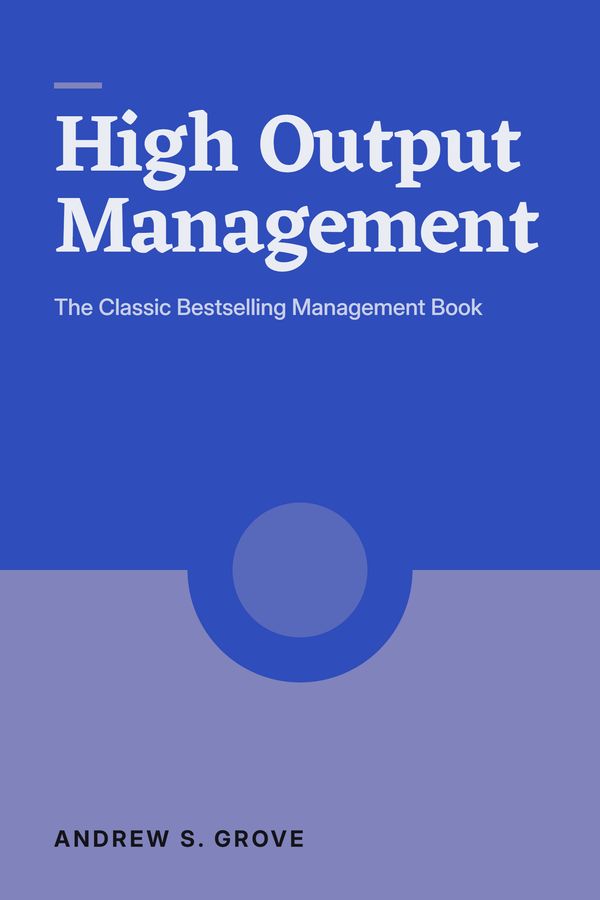
High Output Management summary
The Classic Bestselling Management Book
The book in one sentence
A manager's real job is to lift the output of the whole team, and you do that with leverage, clear indicators, well-run meetings, honest decisions, and feedback matched to each person.
Overview
Andrew Grove ran Intel while writing the manager's field guide that the whole tech industry still copies. His big idea is simple. Your job as a manager is not measured by what you do. It is measured by what your team produces. This book shows how to raise that output through leverage, sharp meetings, clear decisions, and honest feedback.
Key idea 1: Your Output Is Your Team's Output
Ask a manager what they produced today and you often hear a list of things they did. They ran meetings, cleared email, made calls, wrote a report. Grove says none of that is output. It is activity. Your real output as a manager is not what you personally do. It is what your team produces, plus what the teams around you produce because of your influence.
This flips how you judge a manager's day. A busy morning full of tasks can create almost nothing, while one short conversation that unblocks five engineers can be worth more than a week of your own typing. Grove ran Intel, one of the biggest chip makers in the world, and he still thought of himself this way. His job was not to design chips. It was to raise the output of the thousands of people who did.
Grove uses a simple picture. Think of yourself standing in front of your team like a lever. A small push from you moves a large load, because the team does the heavy lifting. So the question every day is not how much you did, but how much the group got done, and whether your actions added to it or slowed it down.
To apply this, start scoring yourself differently. At the end of the week, do not count your tasks. Look at what your team shipped and ask which of your actions actually helped that number. Did your feedback make someone's work better? Did a decision you made let people move faster? If you cannot connect your busy hours to team output, those hours were probably low value.
The nuance is that this includes teams you do not manage. Grove counted the output of neighboring groups you sway through advice, information, or a well-placed nudge. A manager who quietly helps another department hit its target is producing output, even with no one reporting to them. Once you see your job this way, you stop measuring yourself by effort and start measuring by results that show up in other people's work.
7 more key ideas in the app
- 2. Find the Limiting Step
- 3. Pull the High-Leverage Levers
- 4. Measure in Pairs
- 5. The One-on-One Is Their Meeting
- 6. Disagree, Then Commit
- 7. Match Your Style to the Person
- 8. Turn Work Into a Game
Did you know?
- Andrew Grove was Intel's president when this book first came out in 1983, and he later became the company's CEO.
- Grove was born in Hungary in 1936 and fled to the United States in 1956, arriving with little money and shaky English.
- He earned a PhD in chemical engineering from the University of California, Berkeley.
 Hooked
 Lean In
 Loonshots
 Measure What Matters
 Never Eat Alone