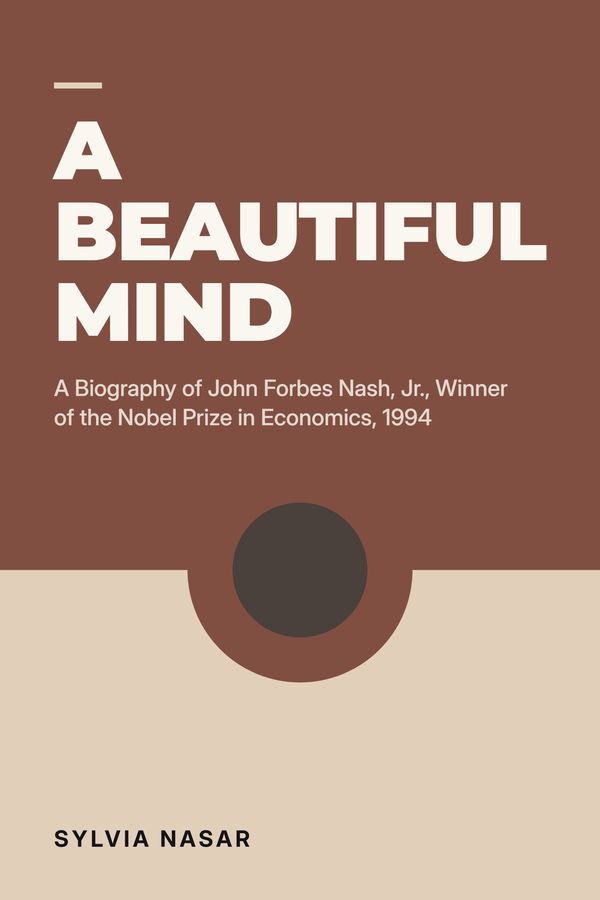
A Beautiful Mind summary
A Biography of John Forbes Nash, Jr., Winner of the Nobel Prize in Economics, 1994
The book in one sentence
The true story of mathematician John Nash, whose brilliant mind produced the Nobel-winning Nash equilibrium and then fractured into three decades of schizophrenia, before a slow, rare recovery and late recognition restored him to the world.
Overview
John Nash was a math genius who won a Nobel Prize for an idea he had at 21. Then his mind broke apart for 30 years of delusions and voices. This is the true story of a brilliant, difficult man and his long, strange road back.
Key idea 1: The Genius Who Didn't Fit In
Sylvia Nasar starts with a young man who was clearly special and clearly hard to be around. John Nash grew up in West Virginia, more at home with books and experiments than with other kids. By the time he reached Princeton for graduate school in the late 1940s, everyone could see the raw power of his mind. He solved problems in his own way, from scratch, often ignoring what other people had already proved. His recommendation letter was famously one line: this man is a genius. But the same wiring that made him brilliant made him cold and odd with people. He could be rude, arrogant, and blind to how others felt. He would announce that a hard problem was trivial, then walk off. He treated conversation like a contest to win. Nasar does not clean this up. She shows a person who was gifted and also arrogant, likable and also cruel, all at once. Here is why that matters. We tend to imagine geniuses as wise and kind, or we imagine that great talent excuses bad behavior. Nash was neither excused nor wise. He was simply extreme in every direction. How to apply it: when you meet a very talented person, separate the gift from the character. One does not earn the other. And if you are the talented one, remember that being right is not the same as being decent, and people remember how you made them feel long after they forget your proof. The nuance worth holding is that Nash's strangeness was not yet illness. The distant, rule-breaking mind that produced his best math was the same mind that later slipped into delusion. Genius and breakdown grew from one root, which is part of what makes his story so unsettling.
7 more key ideas in the app
- 2. One Idea That Changed Economics
- 3. The Math He Loved Most
- 4. Love on Difficult Terms
- 5. When His Own Mind Turned on Him
- 6. The Phantom of the Halls
- 7. A Slow Way Back
- 8. The Prize and the Return
Did you know?
- John Nash won the Nobel Memorial Prize in Economics in 1994 for game theory work he did as a graduate student around 1950.
- His famous Princeton PhD thesis, which introduced the Nash equilibrium, was only about 27 pages long.
- Fellow mathematicians often rank his pure math, like the embedding theorem, above the game theory that made him famous.
 A Promised Land
 Alexander Hamilton
 Becoming
 Benjamin Franklin
 Between the World and Me